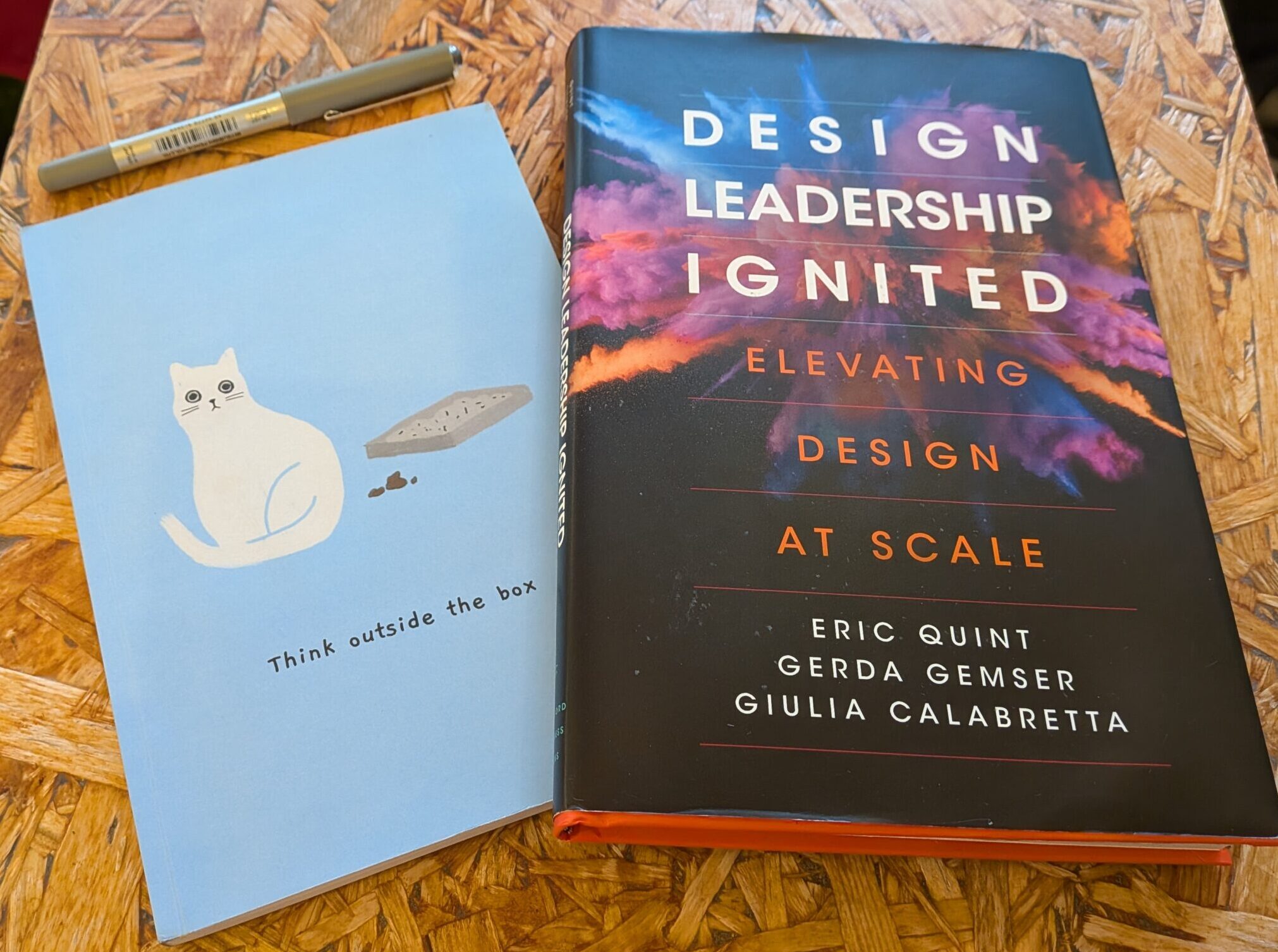
With the objective of stepping up from Senior to Lead User Researcher, I bought a few books on design leadership to improve areas where my skills may need development, as outlined here. One of these books was Design Leadership Ignited, by Gerda Gemser, Giulia Calabretta and Eric Quint. I found it to be a very useful guide, with practical insights into how leaders work – or should work.
The book is divided in 3 main sections:
- Establish the design foundation, where the direction is set and its fit within the organisation is defined. Leaders will create the vision (desired future) and mission (what the team does and why) together with the strategy and operational plans. There should be a clear organisational chart outlining decision-making, lines of authority and reporting structures. There is also a need to define how design is sponsored (paid by business units or by a central design function) and where designers are located (distributed or all together in a design centre).
- Empower the design team within the organisation, by defining a taxonomy (competencies and scope) and resources such as people (working closely with HR) and their roles (including design management, creative direction, design research and design operations) to enable high-quality design work at scale. The leader should be able to attract and retain talent, recognise achievements, and determine when to outsource. They should also define here the resources for performance (methodological toolkit, principles, instruments, protocols, briefs and reviews).
- Elevate to design excellence, scaling and continuously evolving it within the organisation, with growth, efficiency and competitive advantage. The leader should create / expand / maintain demand for strategic and tactical design activities. They should be able to scale design qualitatively (with specialisation and sophistication) and quantitatively (replicating good work, increasing headcount and the designer-to-engineer ratio). Appropriate tools, such as AI, can support this. Leaders should also create demand for design, educating, advocating and evangelising, bringing appreciation and recognition to design excellence that creates value for the business.
Across more than 200 pages, supported by tables and diagrams, the authors present key insights that help design leaders establish effective functions from scratch. They also list the challenges ahead of this quest – it can take several years for it to become a well-oiled machine. But the benefits are clear, for the business and also for the leader, who manage diverse and talented teams and work with stakeholders who appreciate the need for good design informed by solid research.
Reference
Quint, E., Gemser, G., & Calabretta, G. (2022). Design leadership ignited: Elevating design at scale. Stanford University Press.